
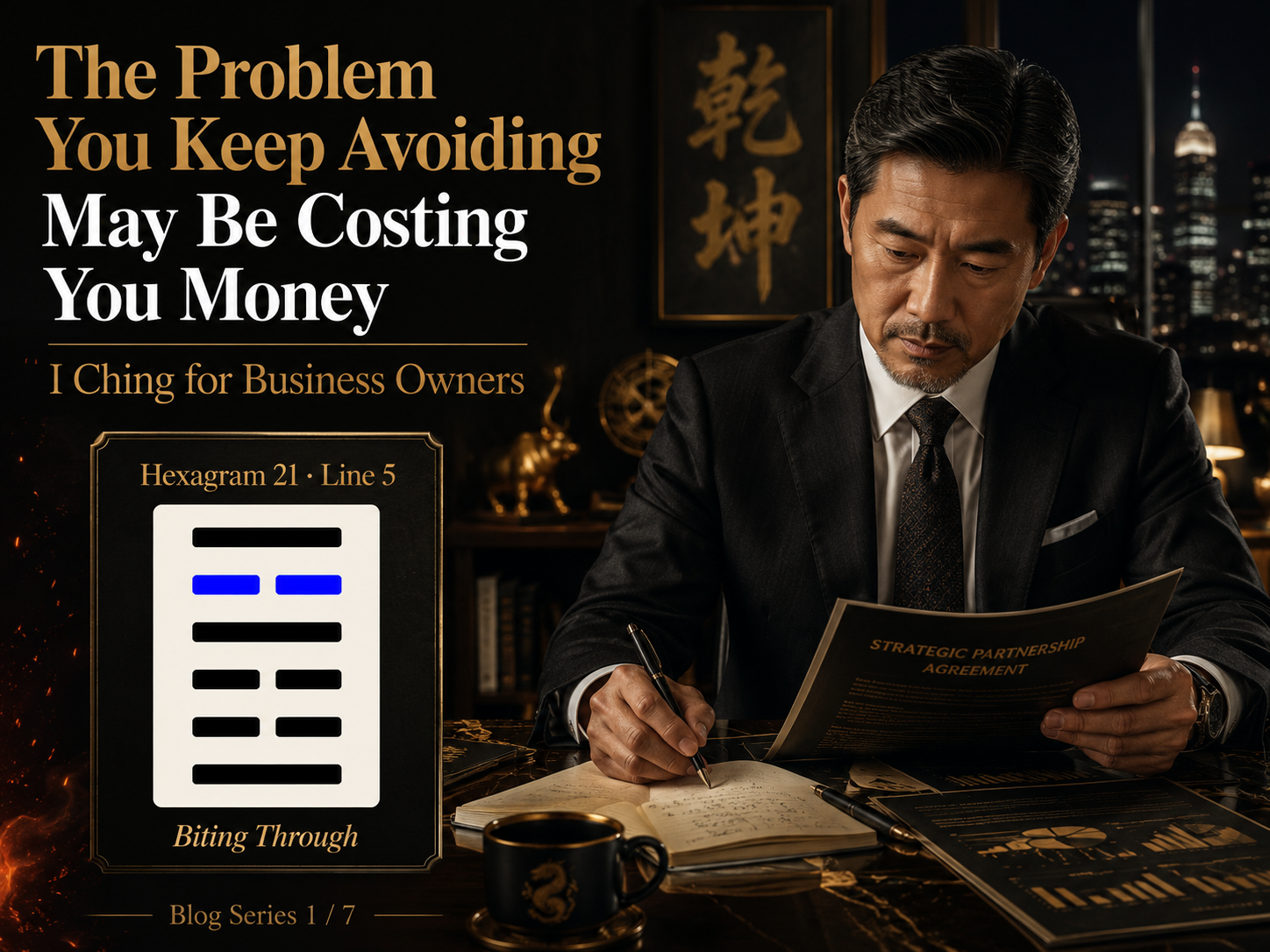
Some business problems begin as small inconveniences.
A payment is delayed.
A contract remains unclear.
An employee’s responsibility is not properly defined.
A partner makes decisions but avoids responsibility when something goes wrong.
At first, it may seem easier to wait.
You may want to protect the relationship.
You may hope the other person will eventually understand.
You may believe that another conversation will only create unnecessary tension.
But unresolved problems rarely disappear.
Instead, they become connected to money, responsibility, authority, and emotion.
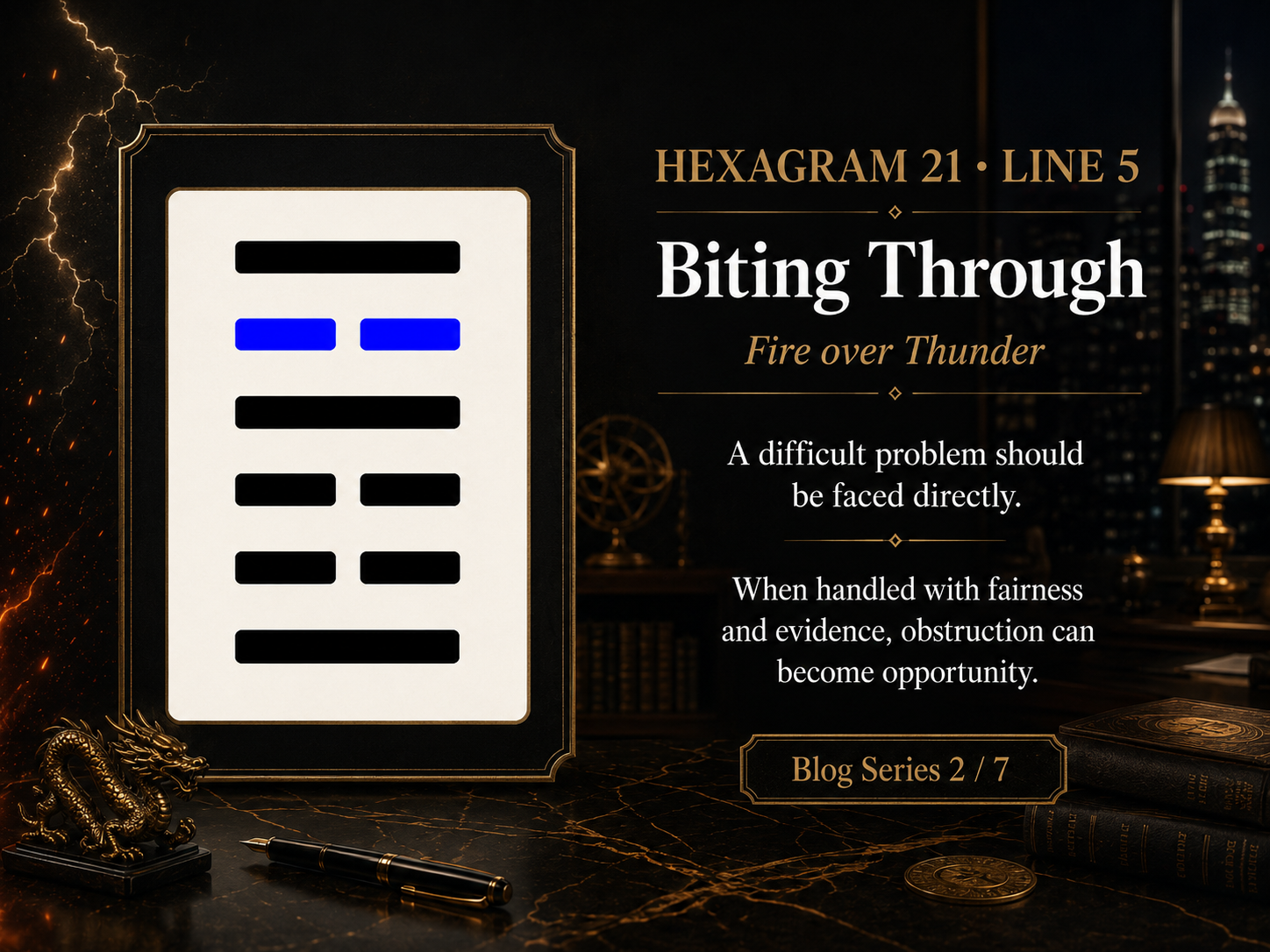
Today’s I Ching lesson for business owners comes from Hexagram 21, Line 5.
It teaches that a difficult problem should not be avoided simply because it is uncomfortable.
When a leader follows clear principles, checks the evidence, and completes the process carefully, a stubborn obstacle can become a source of real value.
A delayed problem usually becomes a larger problem
Every business has an issue that nobody wants to discuss.
A client has not paid on time.
An employee repeatedly ignores a rule.
A business partner’s role is unclear.
A verbal agreement is remembered differently by each person.
The owner may hesitate because the relationship feels important.
Ignoring the issue may appear to preserve peace.
However, silence often creates a new standard.
When one missed deadline is accepted without explanation, the next missed deadline becomes easier to justify.
When one employee is allowed to ignore a rule, others begin to question whether the rule matters.
When authority is given without responsibility, decisions become easy to make but difficult to correct.
The problem is no longer limited to one person or one event.
It begins to affect the entire organization.
Hexagram 21, Line 5 advises the leader to identify what is blocking the proper flow of business and deal with it directly.
The purpose is not to attack a person.
The purpose is to remove the obstruction.
What Hexagram 21 means for a business owner
The judgment of Hexagram 21 says:
噬嗑 亨 利用獄
“Biting Through brings success.
It is beneficial to apply law and discipline clearly.”
The image is easy to understand.
When a hard object is caught between the teeth, the mouth cannot close properly.
The object must be bitten through and removed before normal movement can return.
A business organization works in a similar way.
When payment terms are unclear, money does not flow properly.
When roles are confused, work slows down.
When responsibility is avoided, trust begins to weaken.
When rules are applied differently depending on the person, employees stop following the system and start watching the owner’s mood.
The reference to law and discipline does not mean that every mistake should receive severe punishment.
It means that standards, responsibilities, and consequences should be clear and fairly applied.
A healthy organization is not one without problems.
It is one in which problems are reported early and resolved according to a consistent process.

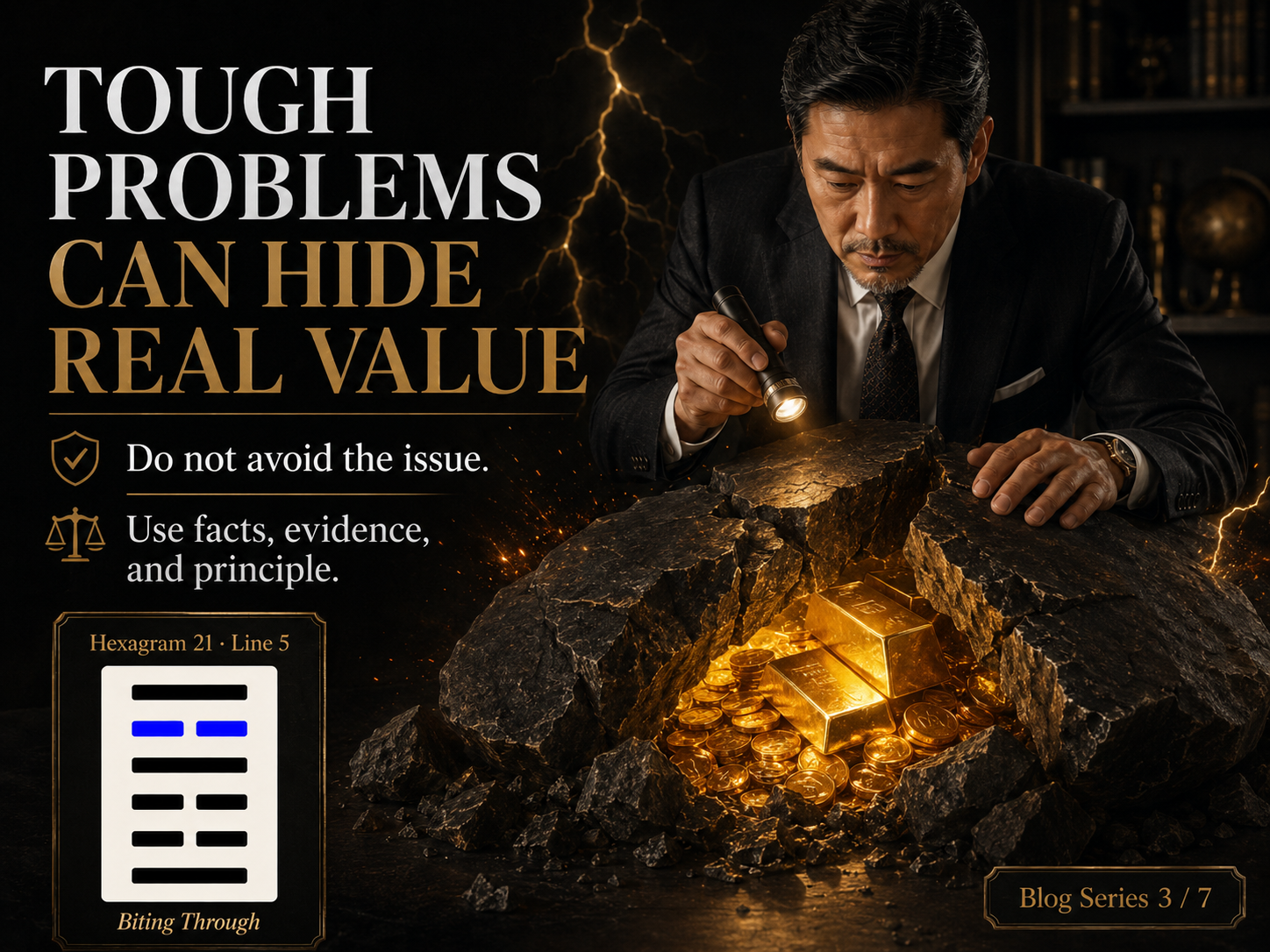
Biting dried meat and finding gold
The fifth line says:
噬乾肉 得黃金 貞厲 無咎
“One bites through dried meat and obtains gold.
Remain correct and aware of danger, and there will be no blame.”
Dried meat is tough.
It cannot be swallowed easily.
It must be chewed patiently and thoroughly.
The problem facing a business owner may be just as difficult.
It may involve a contract signed months ago.
It may require checking invoices, messages, meeting notes, and payment records.
Several people may be involved.
Each person may remember the same agreement differently.
Personal relationships may already be mixed with financial interests.
This type of issue may not be resolved through one short conversation.
However, avoiding it will not make it easier.
The facts must be checked.
Emotions must be separated from evidence.
Responsibility and authority must be clarified.
A final decision must be made and recorded.
According to Hexagram 21, Line 5, gold can be found during this difficult process.
The gold does not only mean money.
It may represent a prevented loss.
It may be a more favorable agreement.
It may be stronger authority.
It may be restored trust among employees.
It may also be a better management system that prevents the same problem from happening again.
https://youtube.com/shorts/1wTv2llZ2B4?si=A4tho8Ut0Almv53f
Firm leadership is different from aggression
This line contains an important warning.
It says that the leader must remain correct while recognizing the danger.
A business owner may have the stronger evidence.
The owner may also have the legal authority to make the final decision.
But having authority does not justify every method of using it.
If the owner becomes emotional, humiliates someone publicly, or refuses to hear the other side, the original problem may create a second conflict.
Firmness means keeping the standard consistent.
Aggression means forcing another person to submit.
These are not the same.
Suppose an employee makes a serious mistake.
Shouting may look decisive, but it does not necessarily prevent the mistake from happening again.
A more effective response is to identify the rule that was broken, explain the effect of the mistake, clarify responsibility, and improve the process.
The same principle applies to unpaid money.
Instead of saying,
“Why do you never keep your promise?”
organize the matter around verifiable facts:
- The agreed amount
- The original payment date
- The unpaid balance
- The new deadline
- The action that will follow if payment is not completed
The business owner’s goal should not be to win an argument.
The goal should be to end the problem.
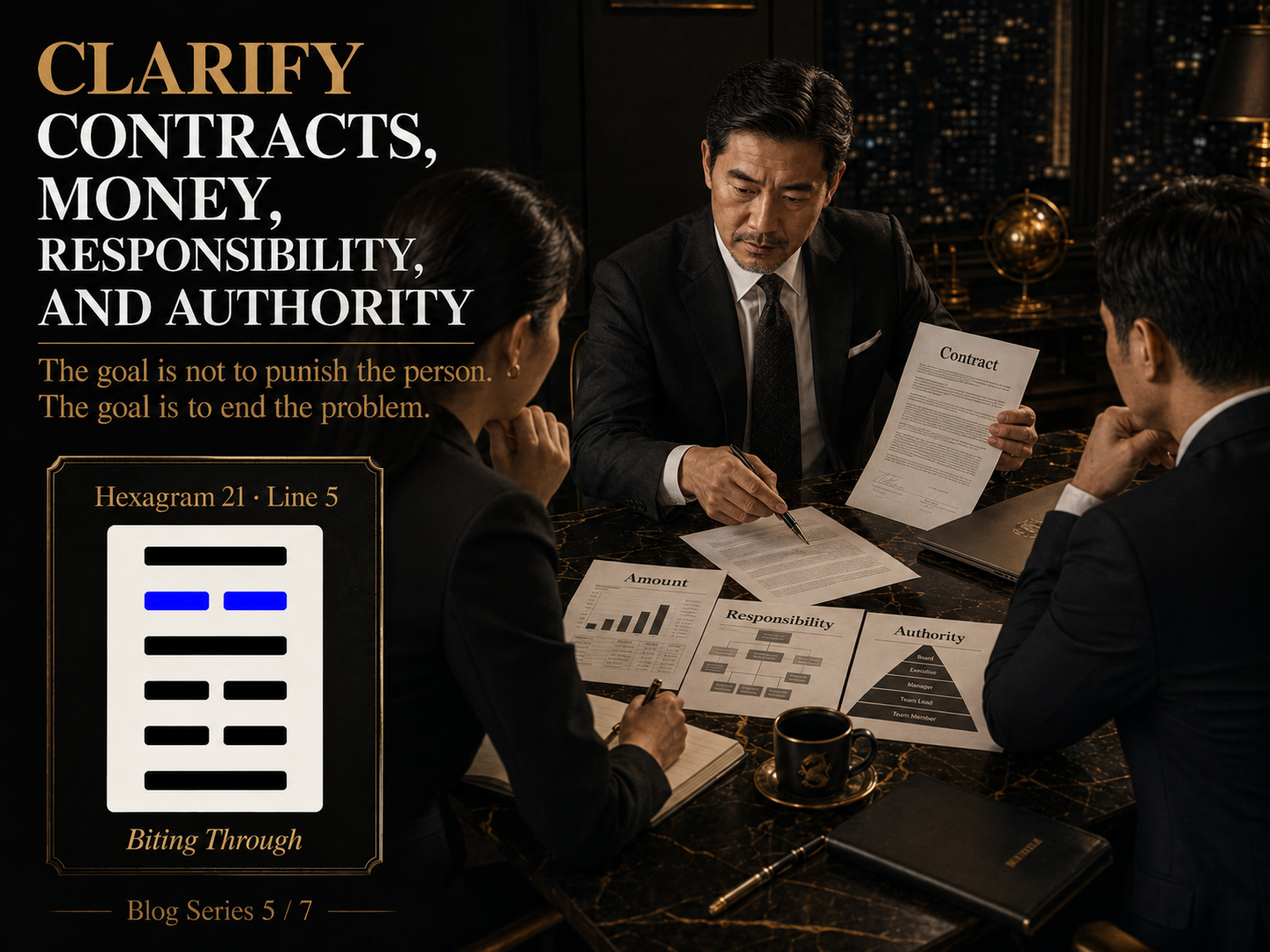
Clarify contracts, money, responsibility, and authority
Today, review the parts of your business that remain vague.
Was an important agreement made only through conversation?
Is the payment amount written clearly?
Is the payment date fixed?
Does everyone know who is responsible when something goes wrong?
Does the person with decision-making authority also accept responsibility for the result?
Many business conflicts begin without deliberate dishonesty.
They begin because expectations were never properly defined.
People remember spoken agreements differently.
The meaning of words changes when money or responsibility becomes involved.
Even close relationships need written standards.
A contract is not always a sign of distrust.
A good contract can protect a relationship by preventing different memories from becoming a dispute.
After an important meeting, summarize the conclusion in writing.
State what each person must do.
Set the deadline.
Confirm the amount.
Define what will happen if the agreement is not fulfilled.
A clear written conclusion prevents the same issue from returning in a different form.
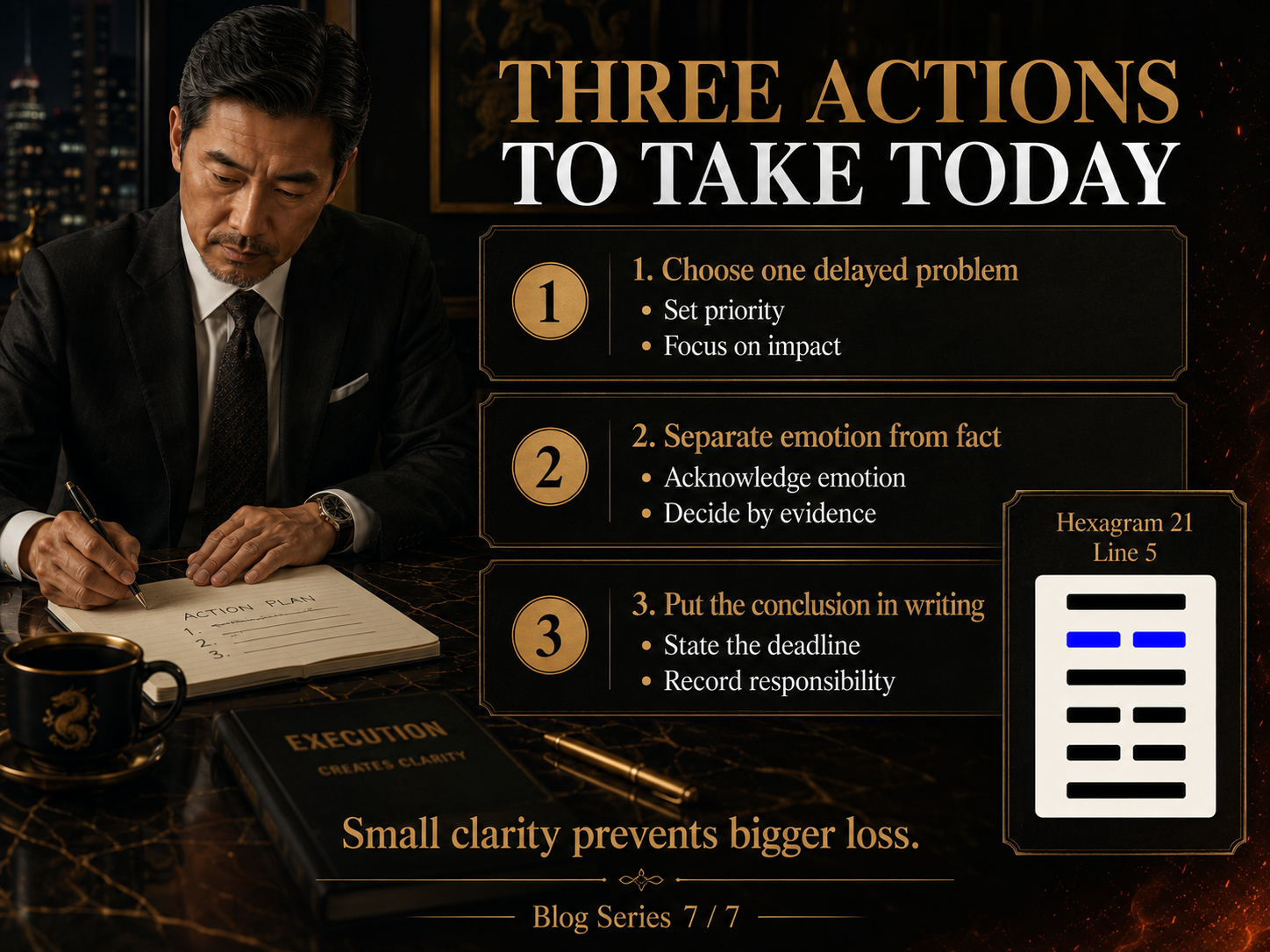
Three actions a business owner should take today
1. Choose one problem you have been avoiding
Do not try to resolve every problem at once.
Choose the issue that is creating the greatest financial loss, confusion, or delay.
A focused decision is more useful than a long list of worries.
2. Separate emotion from fact
“I feel disrespected” is an emotional response.
“The payment is ten days late” is a verifiable fact.
Both may be real, but they should not be treated in the same way.
Acknowledge the emotion.
Make the decision based on facts, records, and evidence.
3. Put the conclusion in writing
If a meeting takes place, record what was decided.
If an agreement is reached by phone, confirm it by message or email.
Clarify the deadline, amount, responsibility, and next action.
A spoken decision can be forgotten.
A written decision can become a standard.
The real reward may be hidden inside the problem
Business owners often see a problem as evidence that something has failed.
But a problem can also reveal the weakest part of the organization.
A payment dispute may reveal that the billing system needs improvement.
Employee conflict may reveal that job descriptions are unclear.
A contract dispute may reveal that the company’s standard agreement is too vague.
A disagreement between partners may reveal that authority and responsibility were never properly divided.
This is why Hexagram 21, Line 5 describes finding gold while chewing dried meat.
The process is unpleasant.
It requires time, evidence, patience, and courage.
But the result can be valuable.
The business may gain a stronger contract.
The organization may gain a fairer rule.
The owner may recover authority and trust.
The company may build a system that prevents future losses.
The gold is not always found after the problem disappears.
Sometimes, the gold is the new structure created while solving it.
Today’s I Ching message for business owners
“The tougher the problem, the more carefully you must resolve it according to principle. When firmness is balanced with caution, an obstacle can become a source of real value.”
Do not delay the difficult conversation today.
But do not try to overpower the other person.
Review the contract.
Confirm the numbers.
Clarify the responsibility.
Define the authority.
Record the final decision.
Hexagram 21, Line 5 does not advise blind force.
It advises fair and decisive action based on evidence, procedure, and consistent standards.
Do not punish the person simply to express your anger.
Remove the problem so that the business can move forward again.
What difficult issue have you been postponing in your business?
Is it related to a contract, an unpaid amount, an employee, or a business partner?
Share the situation in the comments.
Let us examine it together from the perspective of the I Ching.