
When business slows down, many owners instinctively increase the pressure.
They ask employees to work faster.
They demand more frequent reports.
They push for quicker decisions and immediate results.
However, the harder a business owner pushes, the more complicated the organization may become.
Employees stop sharing bad news.
Small problems remain hidden.
Mistakes are covered up until they become expensive.
Today’s I Ching for business owners offers an important lesson about this situation.
The message comes from Hexagram 10, Line 2, traditionally known as Treading or Conduct.
Its advice is simple:
Walk steadily on a clear path, remain true to your principles, and avoid unnecessary pressure.
For a business owner, this means that leadership is not about forcing people to move faster.
It is about creating a direction that people can follow without fear.

Why Employees Hide Problems
Every business owner wants results.
Sales must increase.
Customers must be satisfied.
Deadlines must be met.
Costs must remain under control.
Because owners are responsible for the entire business, every delay can feel urgent.
Employees, however, usually see only the work directly in front of them.
This difference in perspective can create tension.
The owner thinks:
“Why is this taking so long?”
The employee thinks:
“My boss does not trust me.”
When this pattern continues, employees may stop focusing on doing good work.
Instead, they begin focusing on avoiding blame.
That is when an organization becomes vulnerable.
Employees may delay reporting mistakes.
They may offer optimistic updates even when a project is in trouble.
They may hide customer complaints because they fear criticism.
One of the most important lessons from the I Ching for business owners is that fear does not create efficiency.
It creates silence.
And silence allows small problems to grow.
A healthy organization is not one without problems. It is one where people can report problems early.
What Hexagram 10, Line 2 Means
Hexagram 10 is associated with careful conduct.
It describes the importance of knowing how to move through a sensitive situation without crossing boundaries.
In traditional imagery, it is often compared to walking close to a tiger.
The lesson is not that we should become fearful.
The lesson is that power and danger require awareness.
For business owners, authority is a form of power.
A manager’s words affect employees more deeply than the manager may realize.
A casual criticism can reduce confidence.
An angry reaction can prevent honest reporting.
An unclear instruction can create confusion throughout the organization.
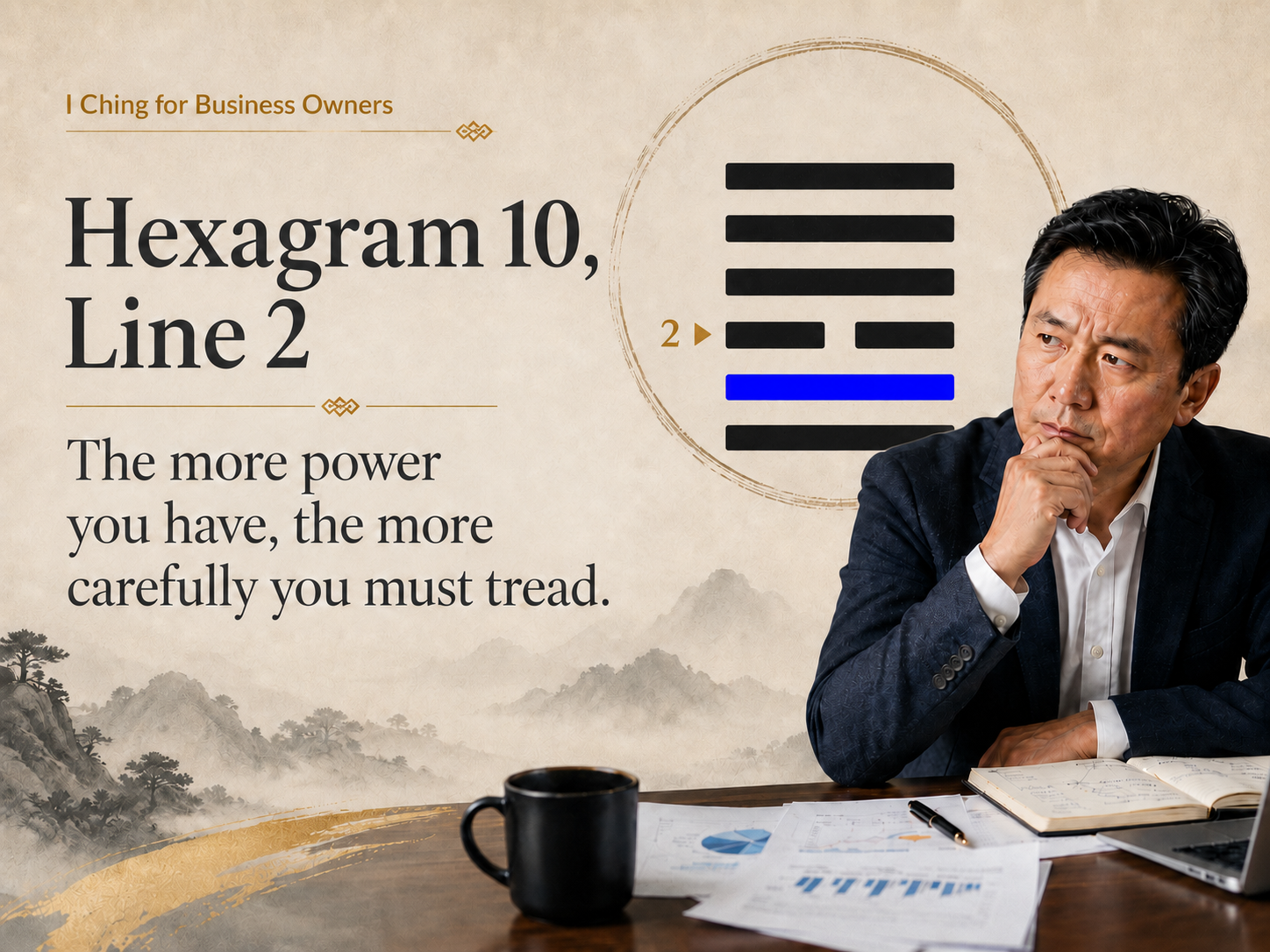
The second line of Hexagram 10 says:
“Treading a smooth and level path. The quiet and steady person remains correct and fortunate.”
This line does not promise sudden success.
It recommends calm, consistent progress.
For modern business leadership, the meaning is clear:
Do not search constantly for dramatic shortcuts.
Do not change direction every time results are disappointing.
Do not pressure employees simply because you feel anxious.
Instead, build a business on clear standards, steady processes, and long-term trust.
Ask Better Questions
A business owner’s questions shape employee behavior.
Consider the difference between these two questions:
“Why is this still not finished?”
and
“What is preventing this work from moving forward?”
The first question sounds like an accusation.
The second question searches for the real cause.
One may create defensiveness.
The other may reveal a missing resource, an unclear instruction, a technical problem, or a customer-related delay.
Another important principle of I Ching leadership advice is to focus on the process before blaming the person.
Before criticizing an employee, ask:
Was the goal explained clearly?
Was the deadline realistic?
Did the employee have enough authority to make decisions?
Was there a system for reporting delays?
Were different departments working from the same information?
Sometimes the employee is not the main problem.
The workflow itself may be broken.
A strong leader does not only demand better performance.
A strong leader identifies what is blocking performance.
Set Clear Standards, but Allow Freedom
Good leadership does not mean leaving employees without direction.
Hexagram 10, Line 2 does not recommend passivity.
It recommends disciplined and appropriate action.
Business owners should make expectations clear.
Employees should understand:
What outcome is required.
When the work must be completed.
Who is responsible.
What budget or resources are available.
When progress should be reported.
However, once the standard is clear, employees need room to think.
If the owner controls every detail, employees stop developing judgment.
They wait for instructions.
They avoid responsibility.
They become dependent on the owner.
This creates a business that cannot function when the owner is absent.
A healthier principle is:
Be clear about the destination, but flexible about the route.
The owner defines the goal.
The employee takes responsibility for execution.
This balance creates both accountability and growth.

Avoid Business Shortcuts
Business owners are constantly offered shortcuts.
A marketing service promises instant traffic.
A new investment promises rapid profit.
A consultant promises to double sales.
A partnership appears to offer easy expansion.
Some opportunities may be valuable.
But speed alone does not make an opportunity good.
Before making a major decision, consider three questions:
1. Does this opportunity produce real profit?
Revenue growth is not always profitable growth.
More customers can also mean higher labor costs, more complaints, and greater operational pressure.
2. Can the business support the new scale?
Expansion without systems can damage service quality.
A company may grow faster than its people, cash flow, or internal processes can handle.
3. Is responsibility clearly defined?
Before signing a contract, confirm who carries the risk when something goes wrong.
A vague agreement can become an expensive problem later.
Hexagram 10, Line 2 teaches that the safest path is often the most sustainable one.
The smooth road may not look exciting.
But it allows a business to continue moving forward.
Why Consistency Beats Urgency
Many business owners believe growth requires constant change.
They change prices.
They change marketing strategies.
They replace employees.
They launch new services.
They enter new markets.
Change can be necessary.
But constant change can also destroy stability.
Customers become confused.
Employees lose confidence.
The brand loses its identity.
The I Ching for business owners encourages leaders to distinguish between useful change and anxious movement.
Before changing direction, ask:
Is the current strategy truly failing?
Have we followed it long enough to measure results?
Are we reacting to data or emotion?
Are we solving the real problem?
Would improving the current system be better than replacing it?
Sometimes a business does not need a new direction.
It needs stronger execution of the existing direction.

Three Actions for Business Owners Today
Hexagram 10, Line 2 offers practical advice that can be used immediately.
First, change one accusation into a question
Instead of saying:
“Why did you make this mistake?”
Ask:
“What caused this problem, and how can we prevent it next time?”
This changes the conversation from blame to learning.
Second, delay one important decision
Do not rush a contract, investment, hiring decision, or expansion plan simply because the opportunity appears urgent.
Review the conditions once more.
Look at the risks as carefully as the potential rewards.
Third, spend ten minutes in silence
Business owners receive opinions from employees, customers, partners, and competitors.
But the final decision still belongs to the owner.
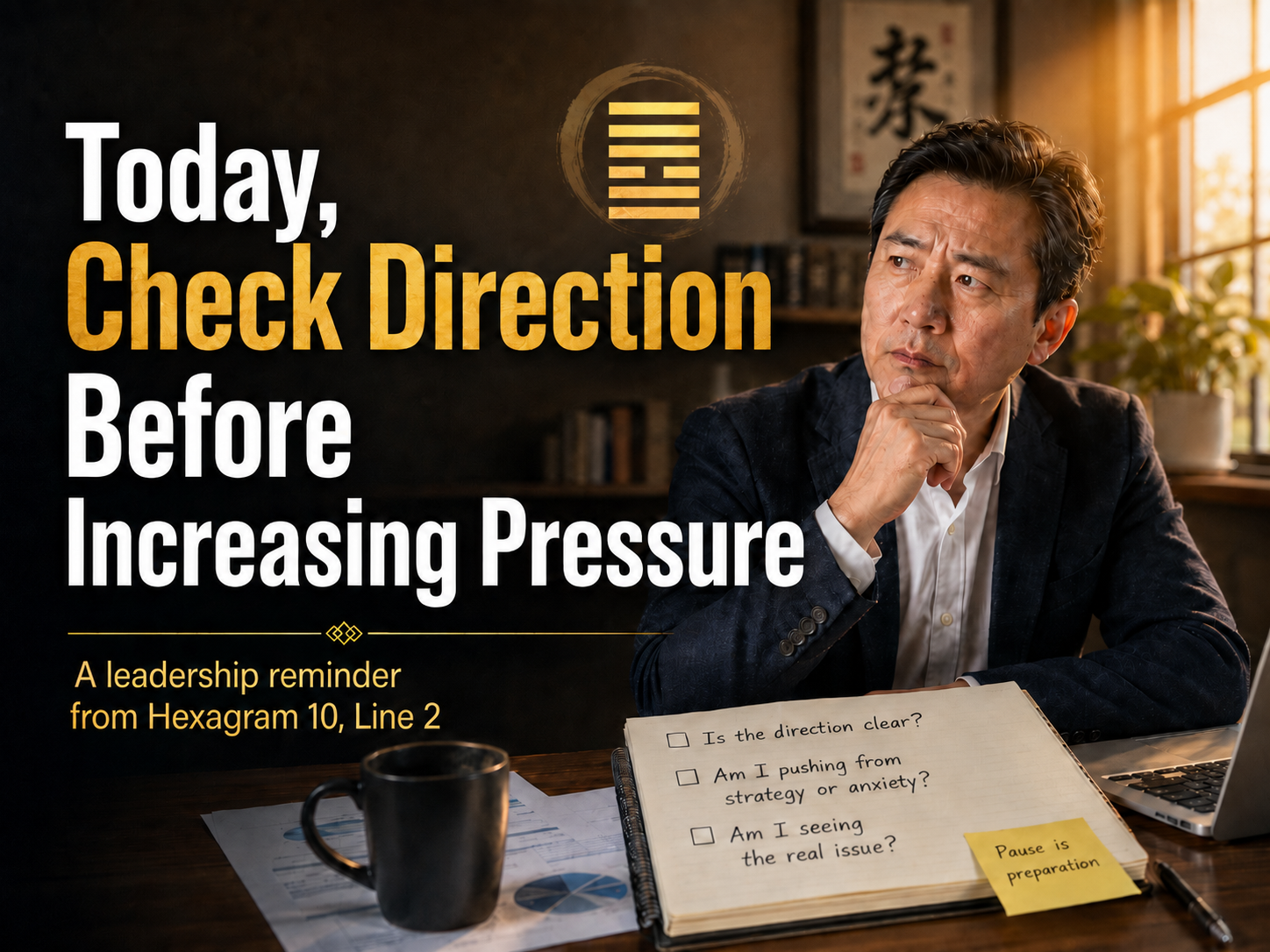
Take ten quiet minutes and ask:
Is this the right direction?
Am I increasing speed because the strategy is good, or because I feel anxious?
Can this approach continue for the next three years?
A short pause can prevent a long mistake.
https://youtube.com/shorts/PiksbIa5M4k?feature=share
The Leadership Lesson of Hexagram 10, Line 2
The central message of Hexagram 10, Line 2 is not to become slow or overly cautious.
It is to move with awareness.
A business owner should not use pressure as a substitute for leadership.
Employees need clear standards.
They also need enough psychological safety to report mistakes, delays, and risks.
The strongest leader is not always the loudest person in the room.
It is often the person who remains calm when others become anxious.
The person who listens before reacting.
The person who chooses sustainable growth over temporary excitement.
The person who stays on a clear path even when shortcuts look attractive.
Final Thought
A business owner’s job is not to push everyone forward. It is to make sure everyone is moving in the right direction.
Today, before asking your team to work faster, check whether the goal, process, and responsibilities are clear.
A smooth path may appear ordinary.
But the person who walks it consistently will usually travel the farthest.
What business decision are you currently rushing?
Share your situation in the comments, and let us consider it through the practical wisdom of the I Ching.